
Toespraak- 22e Europese herdenkingsdag voor de slachtoffers van terreur
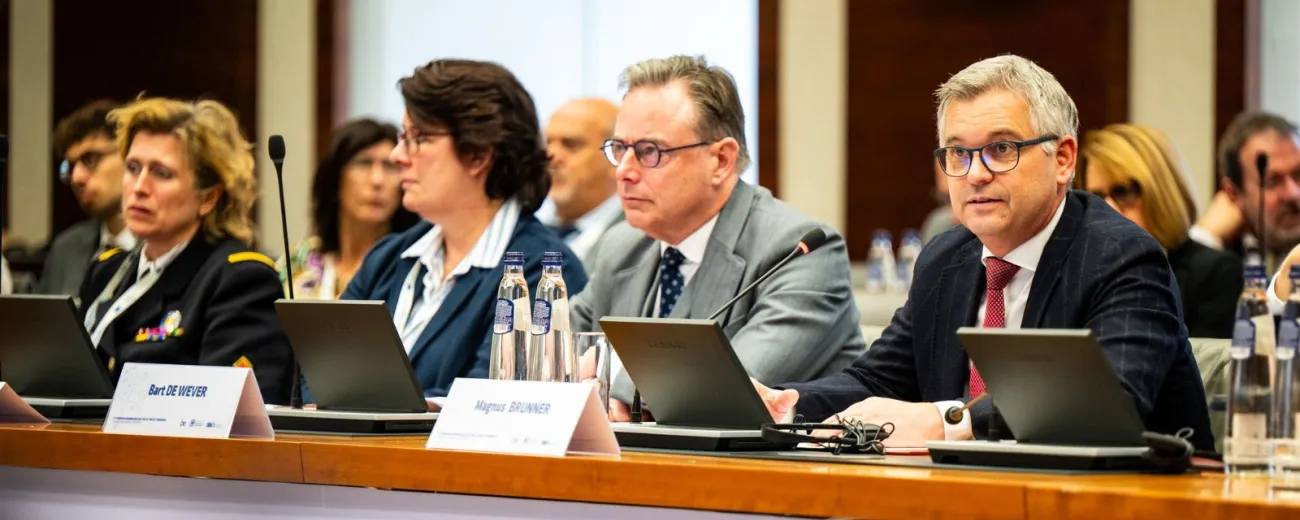
*** Toespraak gegeven op 11 maart 2026. Enkel het gesproken woord telt.***
OPENING REMARKS
Ladies and gentlemen,
Thank you for being here today.
I would like to thank the European Commission, and Commissioner Magnus Brunner especially, for organising this day of remembrance.
On this day, we pause to reflect on the victims and the families behind the attacks.
People with a name and a family, with studies and careers, with love and happiness, illness and misfortune.
People whose lives were taken or shaken to the core.
Today we also pay special tribute to the victims of the attacks of 22 March 2016, here in Brussels and in Zaventem.
Ten years ago, 32 people were murdered. 340 people were injured.
Later, three more people died from the consequences of the attack.
In total, nearly 700 victims were officially recognised.
This day is about all victims of terrorism.
Terrorism makes no distinction. It affects people of all ages, all backgrounds, all beliefs.
*
Ladies and gentlemen,
As the Dutch researcher Teun van Dongen has noted, terrorism is a form of violent political activism.
And the ideological terrorism that has become dominant since the beginning of this century deliberately chooses targets in a way that maximises social impact.
Not to overthrow a government or to change a political system.
But to install fear.
That is why terrorists target places where people gather.
Offices. Metro stations. Airports. Concert halls.
Shopping streets. Bars. Christmas markets. Places of worship.
These are places that represent everyday life.
By striking there, terrorists want to create the feeling that nowhere is safe anymore. That an attack can happen anywhere and at any time.
That is their strategy.
These past twenty-five years have furthermore seen the rise of state-sponsored terrorism.
Globalisation and digitalisation have greatly expanded the possibilities.
Networks can mobilise faster.
Recruitment happens worldwide.
Connections with evil regimes and criminal organisations are easier than ever.
These are two defining features of contemporary terrorism.
It strikes more randomly than in the past. And it has more resources to organise itself.
A small group of perpetrators, supported by a relatively small network, can attempt to destabilise an entire society.
Not because they want to seize power.
But because they want to spread fear.
*
Ladies and gentlemen,
When a terrorist attack occurs, governments often respond in a predictable way.
We provide medical care to victims.
We take security measures.
We ensure that infrastructure becomes operational again.
We restore normal life as quickly as possible.
All that is necessary. We must never allow terrorists to paralyse our daily lives.
Those responsible must be held accountable for their horrific acts as quickly as possible.
But what happens when the airport reopens, when the metro runs again, when the last paving stone is put back in place and the trial has come to an end?
For many victims, that is when the most difficult part begins.
Occupational physician Tine Gregoor happened to be near Maelbeek metro station on 22 March 2016. She immediately helped provide first aid.
She later described how she and other responders acted almost automatically according to a simple principle: treat first what kills first.
First treat the life-threatening injuries. Then the rest.
That reflex saves lives. But it’s the start of what may turn out to be a long healing process.
I share this anecdote because it tells us something.
An attack lasts seconds.
Its consequences last a lifetime.
For victims, everything changes.
Perhaps they were just leaving for a holiday.
Perhaps they had just become engaged.
Perhaps they had just started a new job.
Suddenly their life is reduced to that single moment.
For some survivors, the question “why them and not me?” becomes unbearable.
For others, a long process of acceptance begins.
Governments have not always taken this sufficiently into account.
For too long, they believed their role after an attack was mainly one of crisis management and legal follow-up.
Belgium had to learn this the hard way.
In the years after the attacks of 2016, there was a great deal of anger among victims and their families. Anger about the lack of support and long-term care. And that anger was justified.
A parliamentary inquiry committee established after the attacks taught us important lessons. About security. About crisis management. But also about care for victims.
Those lessons remain essential.
Because an attack does not end when the news fades. It’s not only with us when a commemoration is organised.
For victims, it never truly ends.
Mohamed El Bachiri captured this feeling very well.
He lost his wife in the attack at Maelbeek metro station.
When a former minister, with good intentions – no doubt, told him that the government had not been prepared for an attack of that scale, he replied:
“We, the victims, were not prepared either. But we were the ones who suffered.”
Those words ring true and need to stay with us.
*
Ladies and gentlemen,
As Prime Minister, I cannot promise that terrorism will never strike again.
No one can make that promise.
But I can say that we will do everything we can to not repeat the mistakes of the past.
That is our responsibility.
And it is a responsibility I take very seriously.
That is why it is important that today we listen.
Listen to people who have experienced something no one should ever have to experience.
Their stories remind us what lies behind the memorial plaques.
They remind us why we must never forget.
I would now like to give the floor to their testimonies.
CLOSING REMARKS
Chers Philippe, Pascal, Gauthier et Bruno,
Je voudrais vous remercier de tout mon cœur d’avoir partagé vos histoires avec nous.
Liebe Amal,
Vielen Dank, dass Sie Ihre Geschichte mit uns geteilt haben. Das erfordert viel Mut. Danke auch, Yuri, für das, was Sie getan haben.
Cara Laura,
Grazie mille per aver condiviso la tua storia con noi.
Ladies and gentlemen,
It takes courage to go back to a moment that scarred your life forever.
It takes courage to share those memories with others.
I’m reminded of something I read in the powerful book Bombs in Brussels (Bommen in Brussel), in which survivors and family members of victims tell their stories.
Nidi Chaphekar, a former flight attendant from India, was one of the people who survived the attack in Zaventem. Her photo circulated around the globe and became a symbol of that day.
She said:
"By sharing our stories with others, we make ourselves and others stronger, more loving, and braver."
Today, we have listened to stories like hers.
But for you, the victims and the survivors, it doesn’t stop there.
You live with them, every day of the year.
I recently received a letter from Nebojsa Boltar.
He could not be with us today, but I am grateful to be able to share his words here.
Nebojsa had come from Bosnia and Herzegovina to Brussels for a seminar.
On the morning of 22 March 2016, he asked the hotel reception for a taxi to the airport, together with a colleague.
The hotel staff warned him – Brussels being Brussels – that traffic was heavy and that the taxi would likely be delayed.
But surprisingly, the taxi eventually arrived a little early.
"If the taxi had been late, we would not have arrived in time," he wrote.
Nebojsa was injured in the attack in Zaventem.
After briefly losing consciousness, he found his colleague just outside the departure hall. Like him, his colleague was bleeding from his ears.
A taxi took Nebojsa to Saint-Luc hospital. After the initial treatment, he drove home with colleagues in a rental car.
It was a journey of nearly two thousand kilometres.
But he had promised his family that he would get home.
Along the way, in Germany, he needed to be treated again.
In his letter, he wrote:
"That unfortunate event cost me my mental and physical health in the long term. The trauma is too deep. My life has never been and will never be the same again."
Yet, despite everything he endured, he has shared his story with us today.
Out of curiosity, I looked up the meaning of his first name.
Nebojsa means: fearless.
His testimony shows us the courage it takes to speak out, even after experiencing profound trauma.
It encourages us to keep telling these stories.
To not focus on the fear that terrorists try to spread.
But to listen to the courage of those who continue to speak, and who will not be defined by violence.
The true defeat of terrorism is when a society refuses to lose its humanity.
Today, your courage reminds us all of that humanity.
Thank you to everyone who fearlessly shared their stories.
Thank you.