
Rede - IMEC
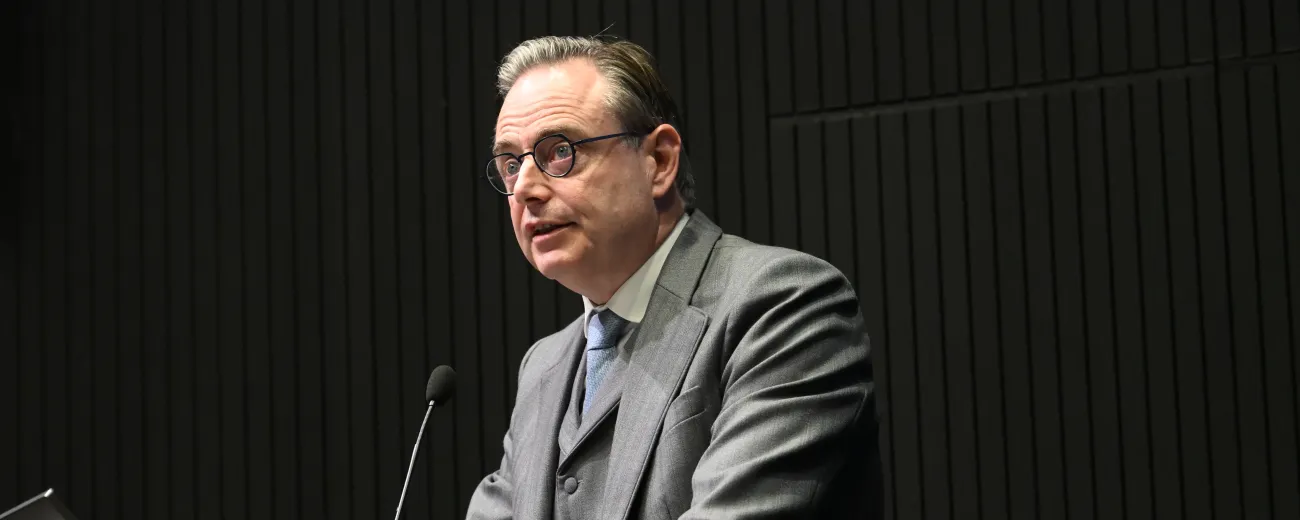
*** Diese Rede wurde am 9. Februar in Leuven gehalten. Maßgeblich ist ausschließlich das gesprochene Wort. ***
Madam Vice-President,
Minister-President,
Dear Luc,
Ladies and Gentlemen,
When Neil Armstrong was asked what his most stressful memory of the Apollo mission had been, he did not talk about the moonwalk.
That, in fact, felt surprisingly comfortable.
The most intense moment came just before the landing.
Alarms sounded. For several seconds, no one knew whether the mission would have to be aborted.
Yet in Houston, a young engineer recognized the error codes. He realized that the onboard computer was simply overloaded. He advised continuing.
And everybody trusted his knowledge.
Because of that, humanity was able to take one of its greatest leaps forward.
This teaches us two things.
Firstly, technological progress knows no bounds.
And secondly, it is the human brain that constantly drives that progress forward.
It is worth remembering that the computer that brought humans to the moon was millions of times less powerful than the smartphone we all carry in our pockets today.
That extraordinary progress rests on one small, now almost invisible invention: the chip.
The chip is the silent engine of our modern civilization.
Without chips, everything comes to a standstill.
*
In the same year as the moon landing, a Flemish engineer – freshly returned from Stanford and the emerging Silicon Valley – wrote something visionary:
“Even if our industry does not manufacture its own chips, it must at least be able to design and test its own chips.”
His name was Roger Van Overstraeten.
In 1984, he founded IMEC.
*
Ladies and gentlemen,
In a small region like ours, prosperity does not lie in the ground.
It lies between our ears.
Knowledge is our most important natural resource.
And that is precisely why this country – and, by extension, Europe – has grown into a global player in semiconductor research.
Today we continue that tradition.
This pilot line is the next milestone in a proud history of achievements.
IMEC was already recognized as a leading spearhead of technological innovation in Belgium and Europe, but today we are also taking a crucial step in our joint chip strategy.
This pilot line is not just a research facility. It is a strategic instrument. Here, we reduce the distance between fundamental research and industrial production.
And that was necessary.
Because let us be honest.
Europe possesses world-class research.
But too often our ideas remain in the laboratory, while commercialization and production take place elsewhere.
There is still a gap between invention and industrialization. There are many steps in between, like application, commercialization and production.
This pilot line builds a bridge across the gap between the lab and the fab.
And it is precisely such bridges that Europe needs today.
*
Ladies and gentlemen,
With the revision of the EU Chips Act ahead of us, we must take a sober look at our strategy.
We do not need ultraviolet light to do so. Plain daylight will suffice.
And in that daylight we must acknowledge something uncomfortable:
Europe is not leading the global technological race.
In the most recent technology tracker of the renowned Australian Strategic Policy Institute, the European Union as a bloc leads in only 4 of the 74 technologies of the future. China dominates.
The United States and China are moving quickly, investing massively, and seeking control over the entire semiconductor value chain.
Europe, by contrast, risks planning too much, regulating too much, and setting objectives that sound appealing but are not very realistic.
The latest OECD Economic Outlook emphasised that in the European Union, more than twice as many people work on implementing and monitoring rules than on innovative research. We have a structural disadvantage in this area compared to the United States.
Yes, the Chips Act has given innovation and research a strong boost.
But when it comes to large-scale production, we must be careful not to chase illusions.
Project after project is postponed or cancelled. Procedures are complex. Rules are heavy. Decisions take too long.
Some seemed to dream that we could simply copy the Taiwanese production model to Europe. That is understandable, because if Taiwanese production stops, every factory in the world will grind to a halt within weeks.
But Europe cannot simply become a second Taiwan. Even if it wanted to.
Europe will not win by trying to outbid China or outscale Asia.
That battle is neither realistic nor wise.
We must focus on our industrial strength, but in doing so we must pay particular attention to preserving and strengthening the industry we have, rather than dreaming about the industry we do not have.
Our strength lies elsewhere.
Our strength lies in the technologies on which everyone else depends.
Whoever masters the most advanced lithography machines,
Whoever develops the next generation of process technology,
Whoever designs and tests the chips of the future,
Makes every factory in the world dependent on them.
That is true sovereignty.
Not wanting to do everything ourselves, but being indispensable to everyone.
Not owning the vertical value chain, but becoming the indispensable link that keeps the horizontal value chain together.
That is the strategy Europe must follow.
And so Europe must change course – from a power that regulates to a power that innovates.
Therefore, when we speak about the Chips Act 2.0 we must keep both feet firmly on the ground.
Let us invest where we are already world leaders.
Let us connect startups, scale-ups, and industry more quickly.
Let us simplify rules instead of burdening them further.
And let us cooperate with reliable partners.
If we want to strengthen our resilience, we need strong partners to protect our interests. A transatlantic partnership remains paramount in this regard.
Economic resilience does not mean we must do everything alone. It is not Europe First, and certainly not Europe Alone.
But it can be “first in Europe”.
That means investing in innovation and securing the capabilities that truly matter.
It also means protecting our intellectual property. Everyone should play by the same rules.
That way, we ensure that when the world builds the future, it cannot do so without Europe.
Projects like this pilot line demonstrate how this can be done.
They turn innovation into economic strength.
*
Ladies and gentlemen,
The cooperation between IMEC and ASML is a perfect example.
I would therefore like to sincerely thank everyone who has made this possible:
• the researchers, the engineers, the technicians, the entrepreneurs,
• the Flemish government for its strategic support,
• and the European Commission for its contribution and its trust.
We need more projects like this.
Because this is Europe at its best.
Here, we truly lead.
And for me personally, this intellectual partnership between Belgium and the Netherlands is also a fine example of how the Low Countries form the beating heart of European progress.
*
Ladies and gentlemen,
This pilot line shows that Europe chooses to lead through knowledge.
At a time when our soft power is drying up and hard power is not immediately achievable, we must fall back on our absolute strength: being a smart power.
We will win by being smarter.
By being indispensable.
By building the technologies the world cannot do without.
And this pilot line makes Europe indispensable.
Thank you.